
Operationalizing biometric training data for generative AI imagery
Mockup of Getty Images Contributor App
Timeline: July 2021 - September 2021 (3 months)
Responsibilities:
User research
Content strategy
Support materials
Stakeholder reviews
Team:
UX writer (me)
Product designer
Research coordinator
Contributor relations
Legal counsel
Data science
Development
-
Getty Images is a leading global source of visual content, offering mid to large-sized companies over 415 million assets from over 340,000 contributors. Getty's research, including customer satisfaction surveys, showed that customer content needs were evolving quickly over time: customers were searching for more diverse and inclusive imagery and wanted to spend less time finding the right image for projects.
The increased demand for quick, unique, quality content revealed new opportunities for the business to explore: what if we could build a better search tool using artificial intelligence, that allows Getty’s customers to generate and/or modify images that meet their project needs in the blink of any eye?
The problem was that we could not currently support the development needed (AI training datasets) to build powerful search and data products because we were not currently asking models to consent to the use of biometric data with our existing model release.
-
As a cross-functional team, we looked at the contributor experience from different angles including contributor relations, data, product, and legal. Together, we redesigned our existing model release and contributor submission workflow to allow contributors to easily shoot, submit, and learn about imagery that was fully released for the use of biometric data.
Our goal was to obtain 100K assets within 3 months to build an AI/ML dataset, at 20% adoption/opt-in rate by models. We believed that if we enabled a biometric release workflow for contributors, we could:
(biz) unlock an estimated AI/ML opportunity of $3M, growing to $10M in 2025
(user) provide our customers with more powerful search and data products
(tech) keep pace with modern data privacy rights and advanced technologies.
What is biometric data and why should our contributors care?
DISCOVERY
As the research lead on this project, I worked collaboratively to develop relevant questions, create a research plan, and write a research script for moderated sessions with Getty contributors. Based on notes from cross-functional partners, I thought about what we could learn from contributors about their current workflow using model releases and how a new biometric model release would fit into that process.
It was important to us to focus on the language in our research because we wanted to capture the initial sentiment of biometric data and understand the comprehension levels of biometric data with our contributors. Insights would be used to help us think about how to speak in the contributors’ language, where we could provide the most impact in their flow, and identify knowledge gaps.

INSIGHTS & THEMES
Interviews revealed that our contributors have different levels of exposure to technology and related terms. We heard things like “that’s google-dee-goop” and “it’s getting too personal.” Some contributors were skeptical of the concept of biometric data overall, while 2 out of 6 contributors felt positive about possibilities such as “using [a model's] likeness to create a video game character.”
As the research lead on the project, I synthesized our findings by creating an affinity map and user journey map. One major insight that stood out was that 5 out of 6 participants found the biometric data language "confusing," "wordy," and "abstract."
“The easier the words are, the easier things will be.”
User journey of a photo/video contributor’s workflow. Click image to enlarge.
Pain points:
Time & effort
Speed & accuracy
Opportunities:
Print Release
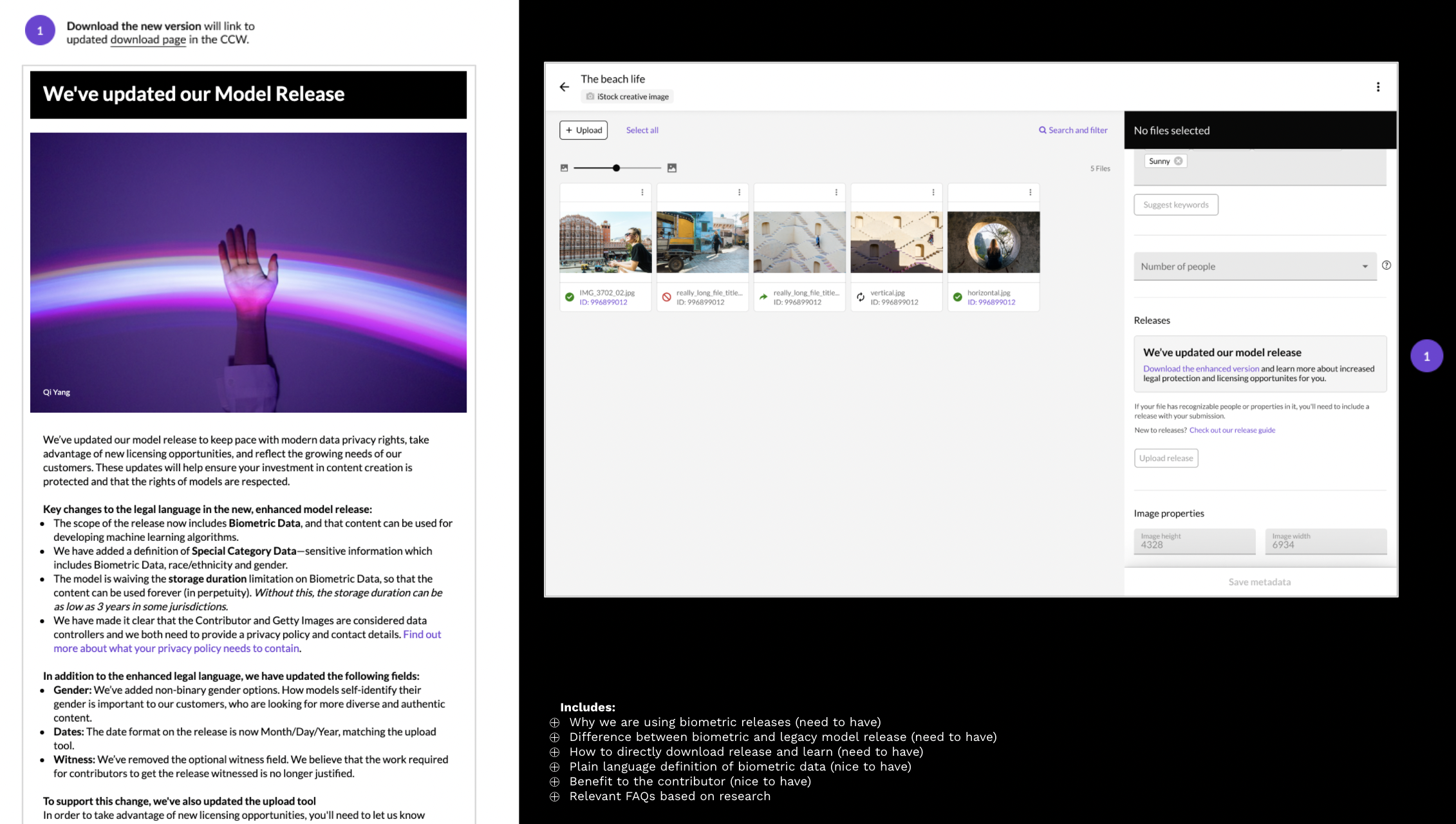
Release Download Page
Metadata Panel
Release Upload Panel
FAQs & Support
Growl Notification
We also found some key themes.
Concerns about specific terms used:
Hang-up phrases like ‘behavioral characteristics’ and ‘facial recognition tools’
Concerns about content usage:
How an image may be altered
The security of the data (i.e. bank, government access)
Lack of confidence in establishing trust between contributor and model due to:
Contributor and model comprehension levels
Ability to explain worst-case scenarios so the model is aware of how an image can be used
How might we enable Getty contributors to submit biometric-released assets to power search and data products?
DEFINING REQUIREMENTS
Presenting these findings to key stakeholders drove alignment for where we should spend our time ideating to make the most impact.
I collaborated with my product manager, research team, and other key stakeholders to gain a clear understanding of the requirements for each area of impact: print release, support articles, and contributor upload workflow. We also identified next steps across various parts of the contributor experience:
Revise copy in the print release (PDF) to address “hang-up” words and sure consent language is user-friendly
Implement design and copy to support usage of the biometric release and in upload/submission workflow
Build supporting documentation to educate contributors about biometric model release
CONTENT STRATEGY
I led the exploration process with a content-first approach, which helped our team align on language cross-functionally, then “plug-and-play” with elements in different areas of the contributor experience.
I established content goals as guardrails going into design work:
Distinguish the new, biometric release from the legacy release
Communicate benefit(s) of using the new, biometric release to the contributor
Make it easy for the contributor to download and learn more about the new, biometric release
Based on research insights, I started categorizing content ideas as “need to haves” and “nice to haves” as prioritization levels and also sizing each element before defining the containers for the content. Frequent stakeholder reviews on exploration & direction also helped us continue to explore solutions and iterate.
-
Why we are using biometric releases (meal)
Difference between biometric and legacy model release (snack)
How to directly download release and learn (bite)
Meal: 2-3 paragraphs | Snack: 1 paragraph | Bite: 1 sentence
-
Examples of real-world AI/ML usage
Plain language definition of biometric data
Benefit to the contributor
Feedback from stakeholder reviews
How do we talk about biometric data throughout the entire contributor experience?
ITERATE & REFINE
Our product lead set up a product roadmap with agile loops to define, design, test, and refine all features for Q1 2021. I co-facilitated testing sessions and co-design workshops with our community partners to validate our assumptions and design decisions as we defined the most viable product.
PRINT RELEASE

METADATA & RELEASE PANEL
SUBMISSION WORKFLOW


SUPPORTING DOCUMENTATION


Impact
IMPACT
The Enhanced Model Release continues to provide the simplicity of the legacy release form, being easy to understand and easy to execute, and accepted across multiple countries and agencies. Operationalizing biometric releases will help customers find or generate "the right image" quicker with AI tools, yet without the right approach, could potentially cause distrust and ethical issues for some.
Paul Banwell, Senior Director of Contributor Relations at Getty Images, stated:
“The importance of developing our model release form to reflect the changes in law and the use of data and imagery was essential to protect the rights of featured models and the livelihoods of our contributors. While Getty Images was promoting industry best practices, we also needed to ensure that we took the rest of the industry on the journey with us to ensure that our contributors would still enjoy the freedom of using a single model release form across multiple agencies if required. Our aim is not to further complicate processes for our contributors, but to ensure that their interests are protected and future-proofed in the ever‑evolving world of data use and protection.”